
 VGR
VGR


Search Product
How To Use Foil Shaver
If you want to use the reciprocating shaver well, the core is that you have to walk in a straight line honestly and never draw circles.
First and foremost, stubble must be short. If your beard has grown into a “beard”, first use a haircut clippers to shorten, reciprocating razors will not eat long hair. The ideal process is: wash your face with warm water first, then dry it thoroughly. Reciprocating razors perform best on absolutely dry skin, or use it in combination with muqian powder.
When shaving, the hand-held shaver should be kept strictly 90 degrees perpendicular to the face. Be sure to use your free hand to tighten the skin, let the beard stand up, and then move in a short straight line against the direction of pore growth. Don’t press hard, let the knife net slide gently on the skin, otherwise you are waiting for “razor burn”. Finally, wash your face in cold water to shrink your pores and apply some alcohol-free aftershave cream to complete the process.
This video demonstrates the preparation and technique for using a foil shaver:
Step 1: Trimming And Drying
Most of the time, it is doomed before you press the switch whether you shave comfortably or with blood all over your face.
The reciprocating razor was engineered to deal with short stubble, not the long, flowing beard. The mesh on the knife net is designed to catch short-haired spines. If the hair is too long, it will only bend and stick on the knife net, and it will not get into the hole at all. As a result, it will hurt and cannot be shaved off.
- Trim first: If your beard has been grown for more than two or 3 days, it is best to use a special beard trimmer or the pop-up trimmer that comes with the shaver to reduce the length of the hair and turn it into a well-treated stubble.
- “Absolute dryness” rule: This is completely different from manual razors, which require foam lubrication, but reciprocating razors are most efficient on dry skin. Moisture causes the tip to drag on the skin, causing it to “drag” rather than “slide”.
- Use beard powder: In order to dry thoroughly, I would recommend using some beard powder or beard stick. These products can absorb excess grease and sweat from the face, create a frictionless surface, and make the beard hard and easier to catch by the knife net.
Step 2: Correct Grip Posture And 90 Degree Angle
Shaving is actually a matter of geometry. Below the thin metal mesh of the reciprocating razor is a blade that oscillates at high speed. In order for these blades to cut effectively, the beard must be drilled straight into the mesh.
- Vertical positioning: Keep the razor at a strict 90-degree angle to the surface of your skin. If you tilt the knife head, one side of the knife net will leave the skin, resulting in uneven shaving. In order to shave clean you have to rub repeatedly in the same place, that’s when the skin irritation comes.
- Continuous adjustment: Your face is contoured-jaw line, chin, neck. When the razor passes through these arcs, your wrist must rotate flexibly to ensure that the head always maintains that vertical contact surface with the skin.
Step 3: Linear Motion And Direction
Of all the wrong tricks I ‘ve seen, drawing circles is definitely number one (that’s the use of a rotary shaver). Reciprocating shavers have to be taken another way.
- Walk only in a straight line: Do a linear movement (up and down or left and right). Do not rotate the fuselage. The inside of the blade is to do linear reciprocating motion, conform to this mechanical principle in order to maximize the cutting efficiency.
- Reverse stubble: it is important to find the right direction of hair growth. Touch your stubble with your hand and feel that the direction of your hand is “reverse stubble”. Shaving in this direction forces the hair into the knife mesh. If you shave along the hair growth, the hair tends to stick to the skin and the knife net slides over to cut nothing.
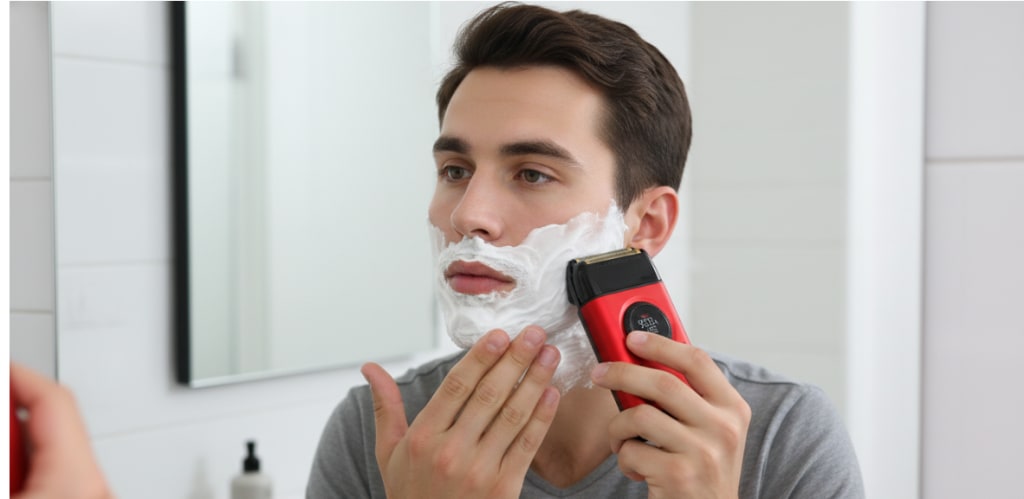
Step 4: Tighten The Skin And Control Pressure
If you want to shave to be extremely clean, it is not how strong you are, but whether you can expose Hu’s roots.
- The role of free hands: the hand that does not hold the razor is not less important than the hand that holds the knife. Tighten the skin with your fingers. Not only does this flatten out wrinkled or loose skin (preventing meat from pinching), but more importantly, tightening the skin forces the hair follicles to stand up, exposing more of the hair shaft to the knife net.
- Zero stress: let the tools do their own work. Reciprocating shavers are now very powerful. If you press hard, you’re actually squeezing the skin into the mesh. This allows the oscillating blade to come into direct contact with your epidermis, resulting in razor burns, redness and tiny cuts. Remember to focus on letting the knife net glide gently across the surface.
Step 5: After-Shave Care
This last step is to ensure that your skin is healthy and quickly recovering from the exfoliation process you just had.
- Rinse with cold water: Although at the beginning we soften the beard with warm water, at the end it is necessary to use cold water. Cold water can excite the skin and force the pores to shrink and close. This prevents dirt and bacteria from getting into the pores and also reduces the inflammatory response after shaving.
- Alcohol-free solution: Throw away those old-school aftershave with extremely high alcohol content, they will only make your skin dry and sting. Instead, apply a high-quality, alcohol-free aftershave. After-shave cream will replenish water, soothe sensitive, repair the skin barrier, and make you feel fresh and comfortable after shaving, instead of burning pain.
Author: Mark Sterling
Hi, I’m a professional barber with over a decade of experience in men’s grooming. I specialize in helping men master their daily routine. In this guide, I share my proven techniques for using a foil shaver—specifically why keeping that strict 90-degree angle and shaving ‘bone-dry’ are the secrets to avoiding razor burn.
